
Opinion,

The urgency of lifting Chile out of severe poverty.

Juan Cristobal Romero, executive director of Hogar de Cristo, Chile.

Chile has made significant progress in reducing poverty by combining economic growth, employment, and well-designed social policies. However, it now coexists with a painful reality: while part of the country debates the pace and models of development, a group of households for whom waiting is no longer an option remains. These are the poorest of the poor.

The experience of the last few decades is clear. The sustainable eradication of poverty depends primarily on households developing skills and pursuing life projects autonomously rather than remaining permanently dependent on the state. The evidence is consistent. When the economy grows, better jobs are created; when there are better jobs, incomes rise, and the real possibility of meeting basic needs improves. By contrast, when growth weakens and social policies become fragmented, poverty reduction slows and becomes more precarious, even amid increased social spending.

That is precisely what we see today. A significant expansion of spending is accompanied by poorly evaluated programs, misaligned incentives, and institutional inertia that does not always correct identified shortcomings. The result is social policy that often addresses immediate needs but fails to change life trajectories.

That said, let’s be clear: capabilities don’t appear on their own, nor are they distributed equally. In contexts of extreme vulnerability, they rarely endure without support. For those living in severe poverty, autonomy is not a starting point but a distant goal. Therefore, social policies have been—and continue to be—fundamental to supplementing incomes and creating the minimum conditions for development. Framing a dichotomy between autonomy and state support impoverishes the debate and ignores the reality of the most marginalized households.

SEVERE POVERTY

Something similar occurs in the debate between targeting and universalization. Democracy is grounded in the recognition of rights for all, as well as in the ethical and political obligation to prioritize those who need it most. The Chilean experience shows that progress in objective assessment and evidence-based resource allocation has helped correct profound inequalities and improve social policies.

Today, we face an even harsher reality. Households are experiencing both income poverty and multidimensional poverty at the same time, and the hope of a better future has all but vanished. We have called this severe poverty, and for these families, cash transfers are necessary but clearly insufficient. Integrated public policies are required that combine income support with social services, care, education, health, housing, and environmental conditions to enable people to build sustainable lives.


Reducing poverty requires a complementary approach: economic growth and job creation; targeted transfers; high-impact health and education policies; and programs that build capacity, without losing sight of the guiding principle of prioritizing those who are worst off. Effective measurement is not merely a technicality; it is essential to ensuring that we address the most urgent needs.

If there is a permanent emergency in Chile, it is not only the one that emerges during election cycles but also the one experienced daily by those who have nothing to lose. Lifting them out of extreme poverty is not merely a slogan; it is an urgent task that demands evidence, consistency, and the will to address what is not working.

 
Make a lasting impact here. Become a recurring donor

HOGAR DE CRISTO USA

Similar Posts

Catastrophic wildfires affect southern Chile

UPDATE January 26, 2026 Hogar de Cristo has been focusing on three areas amid the devastating wildfires in the Ñuble an
Match solidario platform – Hogar de Cristo, Chile

https://youtu.be/cgcuLymmrGA  “Match Solidario” platform – Hogar de Cristo, Chile Creating a direct “match” b

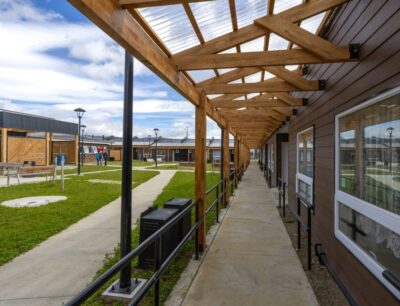
The Shared Housing Condominium, Punta Arenas, Chile.

  The Shared Housing Condominium, Punta Arenas, Chile. A step forward on a long road ahead: Quality Affordable Housing